
Walter Writes Review: What a CMO Actually Thinks After 6 Months of Use

Nobody on my team requested this subscription.
I added it anyway, last November, and watched my Director of Content do that thing she does with her face when she doesn’t understand a decision yet but also won’t ask about it in front of others. Two junior writers went slightly too quiet. I noticed.
Six months of daily use later, here’s the accounting I promised myself I’d write.
Walter Writes is the only tool I’ve found that puts humanization, AI detection, and AI writing in a single editor. For any marketing team running AI-assisted content at volume, that combination changes how you build a quality assurance process. Not because each feature is world-class in isolation. Because having them in the same place removes the friction that kills consistency at scale.
I’ll get into the pricing and the ROI math. First, the problem.
Why enterprise marketing teams need an AI humanizer (and what most get wrong)
Enterprise marketing teams need an AI humanizer because raw AI output fails on two fronts: voice distinctiveness and detection exposure. At volume, AI drafts produce a recognizable rhythm that experienced B2B buyers notice. And a single piece flagged as AI-generated quietly shifts how that buyer reads everything else you send them.
Speed was never the issue. My team was already fast.
What fast was producing wasn’t good enough. Not at the level enterprise buyers hold content to. Raw AI drafts get you to about 60% of where you need to be. Coherent, technically accurate, correctly structured. But experienced readers, and our buyers are extremely experienced readers, have developed something like a texture sense for AI-assembled prose.
The paragraph rhythm is too predictable. Three to four sentences, clean handoff to the next point, repeat. The transitions follow the same short list of patterns. You get the sense that someone sanitized the thing before you arrived. It’s not offensive. It’s just not distinctive. And in enterprise B2B, not distinctive is a credibility problem that compounds quietly over a sales cycle.
The detection risk was a separate problem that arrived at roughly the same time. One of our enterprise prospects ran a case study through a detector and flagged it internally before our next call. We didn’t lose the deal, but the conversation shifted in a way that took weeks to recover. That was the moment I stopped treating this as a future problem. I’ve written about why enterprise brands can’t afford to ignore AI detectability if you want the full picture on that risk.
Walter Writes review: what we tested before committing
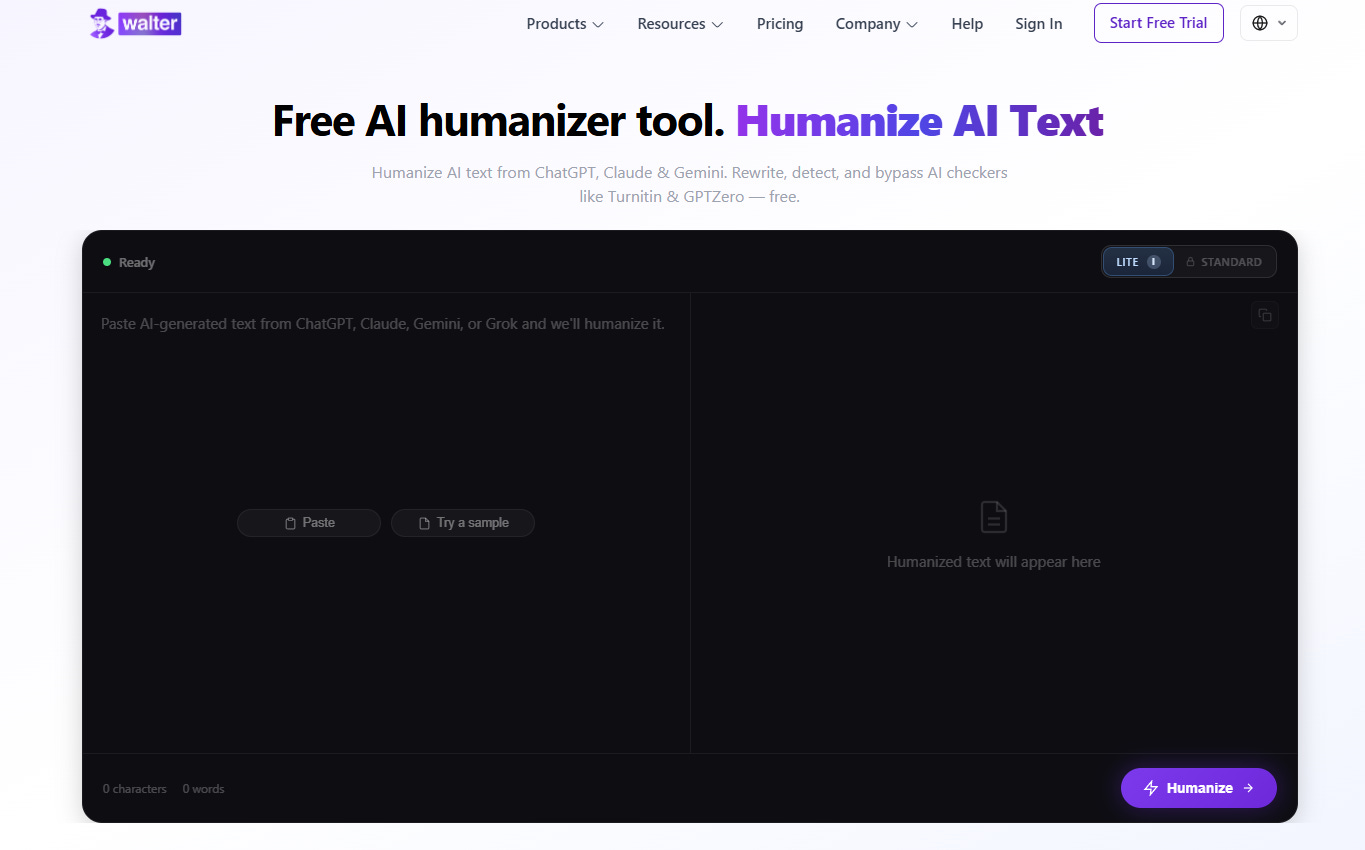
Walter Writes performs where it matters for enterprise use: structural rewriting that passes detection tools calibrated for burstiness and sentence rhythm, not vocabulary substitution. Across 12 executive bylines, multiple case studies, and hundreds of short-form pieces, scores held above 95% human consistently.
Three content categories, actual content, actual measurement.
Executive bylines and thought leadership. We produce a monthly series attributed to our C-suite. These need to pass detection and read like executives wrote them, not like an executive who reviewed something a writer produced. I ran 12 drafts through the AI Humanizer on Standard and Enhanced settings. Scores held above 95% human on the built-in detector, GPTZero, and Originality.ai. The voice came through.
Case studies were the harder test. Analysts download them and read them slowly. Prospects share them internally weeks before you know the deal is moving. We put Claude and GPT-4o drafts through the humanizer. What I noticed, and this is the thing that differentiated it from cheaper tools we’d tried, is that Walter Writes rewrites at the sentence-structure level, not the vocabulary level. Detection tools in 2026 aren’t fooled by synonym swapping. They look at burstiness and rhythm and sentence-length variation. Structural rewriting addresses those signals. Vocabulary swapping doesn’t.
Short-form content was less dramatic but probably the most immediately visible impact. The Chrome extension runs inside Google Docs and Gmail. Content strategists use it to clean up LinkedIn posts, email sequences, short-form copy without leaving the tool they’re already in. The friction reduction compounded across eight people working every day in a way that’s hard to put a single number on.
Walter Writes built-in AI detector: why it changes the workflow
The Walter Writes built-in detector changes the workflow because it removes the step enterprise teams most consistently skip: verification. When detection runs inside the same editor as humanization, teams use it every time. When it’s a separate tool, they don’t — and that gap shows up in output consistency within weeks.
Most teams miss this: humanizing and detecting are the same workflow, not two separate steps.
If you’re running a humanization tool and a detection tool on separate platforms, you’ve created a gap. And in that gap, your team will skip the detection step when they’re under deadline. Not sometimes. Consistently. Because it costs time. Because it means another login. Because the day is already full.
The built-in detector runs against GPTZero, Turnitin, Originality.ai, and Copyleaks inside the same editor where the humanization happens. After every pass, the score is right there. My team runs it because it costs them nothing not to. That behavioral difference, across 40 to 60 pieces per month, produces meaningfully more consistent output quality than any other single process change we’ve made in the last two years.
This is a reliability argument, not a convenience argument.
Walter Writes vs competitors: what I found after testing Undetectable AI and QuillBot
Walter Writes beats Undetectable AI and QuillBot on structural rewriting depth. Undetectable AI changes words but not sentence rhythm — detectable by burstiness analysis. QuillBot lacks adjustable rewrite strength and an integrated detector. Walter Writes addresses both gaps in one platform with three calibrated rewrite levels.
Evaluated three alternatives before committing. Here’s the short version. If you want the longer version, I went deep on four tools earlier this year — methodology, scores, the full breakdown.
Undetectable AI is adequate at vocabulary substitution. My senior strategists figured out its limitation within the first week of our trial: the words change but the sentence rhythms don’t. Detection tools trained on burstiness and structural patterns will catch this. We saw false passes early. Content that scored clean wouldn’t have held up under real scrutiny, and we didn’t figure that out right away.
QuillBot is a writing tool that includes humanization, not a humanization tool. Fine for low-stakes content. No adjustable rewrite strength, no tone modes, no built-in detection. You’re still managing two platforms.
What Walter Writes does differently is the rewrite-strength calibration. Simple, Standard, Enhanced. An internal email or a social post goes through Simple. A CEO byline going into a trade publication goes through Enhanced. That granularity matters when you have a team where different people are working on different content types with very different risk tolerances for getting flagged.
One thing worth naming explicitly: meaning preservation under aggressive rewrites. After Enhanced passes, the facts, citations, and core arguments stayed where I put them. With one of the other tools we tested, an aggressive rewrite introduced a claim that wasn’t in the original draft. Caught in editorial review. But still. Re-review cycles are expensive.
Walter Writes pricing: the ROI case for enterprise teams
$1,188 per year. Ten members. 500,000 words per month.
That’s $99 per seat annually by the math I did for the budget conversation. By any standard for enterprise marketing technology, this doesn’t register as a serious discussion. I’ve covered the full ROI methodology for a 12-person content team in a separate post if you want the detailed calculation.
The ROI case had two parts. Finance understood one of them immediately.
The efficiency case is easy to quantify. Editorial review time dropped roughly 30% on AI-assisted content. Writers submit with less second-guessing because they’ve already run the content through the detector. The coordinator chases fewer revisions. Six writers, loaded cost per hour, do the math.
The risk case is harder, because finance teams don’t have a line for “reputational risk prevented.” My framing: a single piece of enterprise content flagged as AI-generated doesn’t typically kill a deal outright. What it does is end the benefit of the doubt. The buyer starts reading everything else you send them through a different lens: more skeptical, more on guard, looking for the next signal that you’re taking shortcuts. That credibility drain is real, it’s cumulative, and it doesn’t show up in your attribution model until something stalls that shouldn’t have. At $1,188 a year, this is cheap insurance. I got the budget approved.
Where Walter Writes falls short as an enterprise AI writing tool
The AI Writer is functional. It’s not the reason you’re buying Walter Writes.
Outlines, first drafts, content frameworks. It handles those. Strategic positioning, credible executive argument, industry-specific insight still requires humans who understand the subject matter. That’s not a Walter Writes critique. That’s true of every AI writing platform on the market right now. I’m less interested in platforms that try to be everything and more interested in platforms that do one specific thing exceptionally. The humanizer and detector are what Walter Writes does exceptionally. The AI Writer is a reasonable addition.
On the detection landscape: I’ll be candid because vendors usually aren’t. No humanization tool has a permanent lead over evolving detection models. What scores 99% human today is going to be tested by better models within 12 months. Structural rewriting is a more durable approach than vocabulary swapping, and the platform does update regularly, but this is an ongoing arms race. I’m watching it. Any CMO in this position should be.
Is Walter Writes worth it? Two criteria that determine fit
Walter Writes is worth it for enterprise marketing teams producing AI-assisted content at meaningful volume with a brand credibility stake in the outcome. For teams that meet both criteria, the ROI is clear and the risk mitigation case is stronger than the efficiency case.
First: teams producing AI-assisted content at enough volume that workflow friction becomes a real cost. If you’re publishing one or two AI-assisted pieces per month, the free tier covers you. At 15 or more, the compounding cost of managing separate tools and the inconsistency that comes from process gaps starts to matter.
Second: organizations where the downside of a flagged piece is asymmetric. Enterprise decision-makers. Procurement teams. Analysts. Institutional investors. People who read a lot of content and have a calibrated sense of what AI-generated prose looks like. In those audiences, one flagged piece in front of the wrong person isn’t recoverable in a quarter.
Both criteria need to be true. If only one applies, the tool is probably more than you need right now.
Six months in: Is Walter Writes Worth it?
Worth it. Yes.
The condition: you have to implement it as a genuine quality layer, not a box-checking exercise. Teams that run AI drafts through Walter Writes and call them done will see marginal improvement. Teams that treat it as one step in a disciplined editorial process, not the whole process, will produce better content at meaningfully higher volume than they could otherwise.
We’ve run this at scale for six months. The results are real and they held up.